




GA4 Finally Knows When ChatGPT Sent You a Customer


For the last two years, a visitor who clicked from ChatGPT straight into your website showed up in Google Analytics looking exactly like someone who typed your URL from memory. Same bucket, same shrug. On May 13, 2026, that finally changed.
Google added a dedicated AI Assistant channel to GA4’s Default Channel Group. When GA4 can see the referrer on an incoming session, it now tags that visit with the medium ai-assistant, files it under the AI Assistant channel, and marks the campaign as (ai-assistant). No custom regex, no manually maintained channel group, no quarterly did-they-change-their-domain-again check.
At launch, the recognized list was short: ChatGPT, Gemini, and Claude. Marketers who had already built their own workarounds for Perplexity and Copilot pointed out the gap almost immediately, and within about a week Google widened detection to more than twenty AI assistants. That pace of iteration says something on its own. Google is treating this as a live traffic category it plans to keep expanding, not a one time report update.
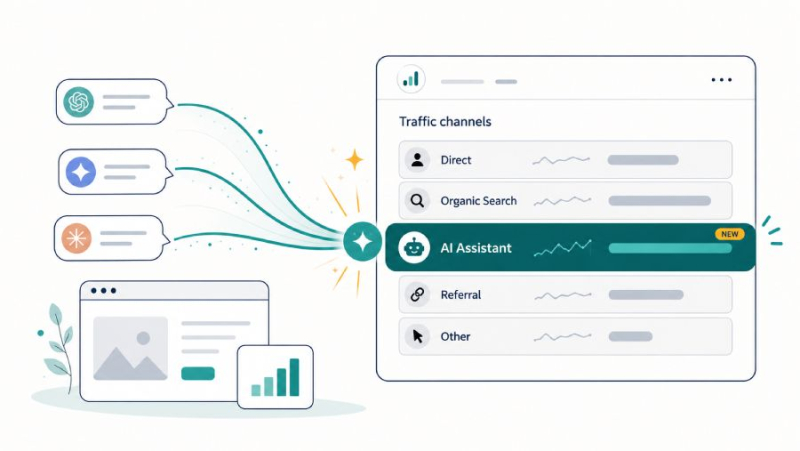
Before this update, AI referral traffic mostly landed in GA4’s generic Referral bucket, indistinguishable from a random backlink or a forum mention. Any analytics team that wanted a real answer to how much traffic ChatGPT is actually sending them had to build a custom channel group with regex patterns matching known AI domains, then maintain it every time a platform changed its link structure or added a new client. That is real setup time spent answering one question, and it breaks quietly the moment a domain shifts.
The new channel does that work by default. You can compare AI referrals against organic search in the same report, see which specific assistant sends the most qualified visitors, and start asking whether those visitors convert differently than a Google search click does. That is a genuine shift: AI driven discovery moves from a theory teams argue about in strategy meetings to a line item you can actually measure.
Two things worth knowing before you trust this channel completely.
First, there is no backfill. GA4 only counts sessions from the day the feature turned on. Whatever AI traffic you had earlier this year stayed invisible, and it will stay invisible. The channel cannot reconstruct it after the fact.
Second, it only works when GA4 can actually read the referrer. A visitor who clicks a link inside an AI app’s in-app browser, copies and pastes a URL from a chat, or opens your site through a mobile client that strips referral headers still shows up as Direct traffic, not AI Assistant. Some of your existing Direct traffic is very likely AI influenced traffic wearing a disguise it cannot take off yet. Do not read a flat AI Assistant number as your full AI traffic total. Read it as a floor.
Open your Traffic Acquisition report this week and look at the AI Assistant row on its own, not folded into Referral or lumped with Organic Search. Note the date the data starts, and do not try to backfill trend lines from before that date. You would just be graphing a reporting change, not real growth.
If you already built a custom regex channel group for AI referral traffic, do not delete it yet. Run it alongside the new native channel for a few weeks and compare the two. Differences between them usually mean one of two things: either your regex list is more current on niche AI tools Google has not added yet, or Google’s native detection is catching sessions your regex missed. Either way, that comparison is more useful than trusting either report on its own.
And watch Direct traffic, not just AI Assistant traffic. If Direct has been creeping up while your organic numbers hold steady, that pattern is worth investigating before you write it off as user error or bookmark traffic. A rising, unexplained Direct trend sitting next to a new AI citation of your brand is not a coincidence you should ignore.
This update is a good example of why a tracking setup needs a second pair of eyes on a schedule, not just at launch. GA4 quietly changes what a channel means, what a medium captures, and what counts as Direct more often than most teams realize, and those changes can silently distort a dashboard someone built a strategy around six months ago.
At Art Division, this is the work we actually do for UK-based estate and letting agents and businesses in the property sector: auditing tracking configurations against what a platform has changed underneath you, reconciling channels that have drifted out of sync with reality, and building reporting that tells you what is actually happening instead of what a default report happens to show.
If you have ever looked at your Direct traffic and had a nagging feeling it was hiding something, that instinct is usually right, and finding it before it costs you a real decision is exactly the kind of work we get called in for.
It is a channel Google added to GA4’s Default Channel Group on May 13, 2026. When GA4 can read the referrer on an incoming session, it tags that visit with the medium ai-assistant, groups it under the AI Assistant channel, and sets the campaign to (ai-assistant). It runs automatically, with no custom setup required.
At launch it only recognized ChatGPT, Gemini, and Claude. Within about a week, Google widened detection to more than twenty AI assistants, closing the gap for tools like Perplexity and Copilot that marketers flagged right away. Google has not published the full list, so treat any given platform as covered only once you see it show up in your own reports.
The AI Assistant channel only works when GA4 can actually read the referrer. Clicks from an AI app’s in-app browser, pasted links, or mobile clients that strip referral headers still land in Direct traffic instead. If Direct has been creeping up, some of it is very likely AI-driven traffic GA4 cannot yet identify.
No. GA4 only counts sessions from the day the AI Assistant channel went live. Whatever AI-driven traffic you had earlier in the year stayed invisible at the time and cannot be reconstructed after the fact, so do not extend AI Assistant trend lines backward past that launch date.
Not for the platforms GA4 now catches natively, but do not delete an existing regex-based channel group yet. Run it alongside the native channel for a few weeks and compare results. Gaps between the two usually point to either a niche AI tool Google has not added yet, or sessions your regex was missing.








"*" indicates required fields