




Lead Generation for Estate Agents: How to Attract and Convert More Valuation Leads


When stock is low, instructions slow down. The fix isn’t just more leads, it’s more of the right leads: vendors, landlords and buyers in your local area who are ready to book a valuation.
Getting there takes proper investment across SEO, your website, PPC, Google Business Profile and more, matched to a clear idea of what a lead is actually worth to your branch.
Two questions come up in almost every conversation we have with agents:
This guide answers both.

Lead generation for estate agents is the process of attracting potential vendors, landlords, buyers and tenants, then converting them into genuine enquiries, booked valuations and, ultimately, instructions.
It helps to separate the stages clearly:
Most agents don’t have a traffic problem. They have a conversion and quality problem: plenty of visitors, not enough of the right vendors and landlords turning into instructions. The goal isn’t just more leads, it’s better local leads that convert.
A few things have changed. Local search results are more competitive, with more agents, portals and comparison sites fighting for the same “estate agents near me” and “house valuation [area]” searches. Portal dependence means many agents still rely on Rightmove and Zoopla for enquiries rather than owning their own traffic. PPC costs have risen in property, so a wasted click is more expensive than it used to be.
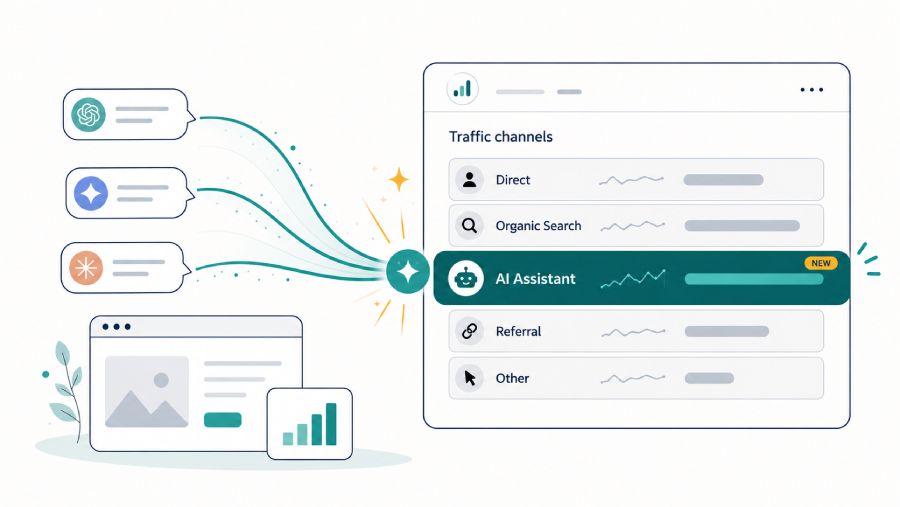
Vendors and landlords also do more research before they ever pick up the phone: checking reviews, comparing fees, reading local content and forming an opinion of your agency before they enquire. Trust signals such as reviews, case studies and clear local expertise now do a lot of the persuading. And increasingly, buyers and sellers start that research by asking AI tools like ChatGPT or Google’s AI Overviews for recommendations, not just Google’s blue links. Once someone does enquire, how fast you respond often decides who gets the instruction.
Here’s where to focus first, starting with the channels that do the most heavy lifting for UK estate and letting agents.
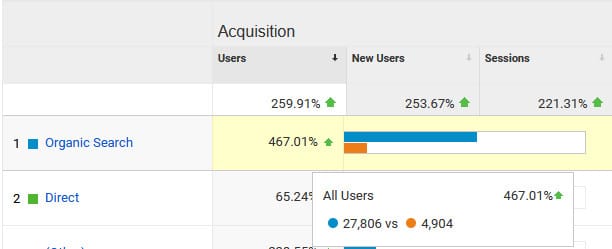
If we had to pick one channel for long-term lead generation, it’s ranking in the top 3 local results for terms like “estate agents in [area]” and “house valuation [area]”. Free, compounding traffic beats paid clicks over time. For many estate agency websites, organic search is one of the largest sources of traffic, making SEO the foundation the rest of your digital marketing sits on.
The compounding effect is the key difference versus paid channels: the same monthly spend on SEO keeps growing your traffic and leads, while the same spend on PPC produces roughly the same result every month. For one two-branch client, comparing the three months after launch in 2020 with the same months two years later, we recorded a 467% increase in organic traffic, which fed directly into more valuation enquiries.
Ranking locally means optimising for your branch areas specifically, not just your agency name, and building the trust signals (reviews, local content, backlinks) that Google rewards in property search results. Our SEO service for estate agents covers exactly this.
Traffic on its own doesn’t pay the bills, conversions do. SEO can fill the top of the funnel, but if your website doesn’t make it easy and obvious to book a valuation, most of that traffic leaves without enquiring.
On the same two-branch client referenced above, pairing the SEO campaign with a website built to convert produced a 1,840% increase in property valuation conversions over the same two-year period. That’s the combination that matters: rank AND convert.
In practice, this means clear “Book a valuation” calls to action on every page, valuation forms that don’t ask for more than necessary, and fast page speed on mobile, where most vendors and landlords will find you first. We design websites for estate and letting agents built around exactly this.
SEO takes time to build. If you need valuation leads now, Google Ads can put you in front of people actively searching for terms like “estate agents in [area]”, “house valuation [area]” and “letting agents [area]” the same day a campaign goes live.
PPC isn’t cheap in property, so tight keyword targeting, area-specific ad copy and landing pages built to convert (not just your homepage) all matter for keeping cost per lead sensible. Our PPC service for estate agents covers campaign structure in more detail.
For “estate agents near me” and “letting agents in [area]” searches, your Google Business Profile often shows before your website does. It’s frequently the first thing a vendor or landlord sees, so it needs to work as hard as your homepage.
Make sure your categories, opening hours and service areas are accurate for every branch, add photos of your team and office, post regular updates, and reply to every review. Consistent name, address and phone details across your website, portals and directories (NAP consistency) also help Google trust your profile enough to rank it locally, which is where most of this traffic comes from.
Social media rarely generates a valuation enquiry directly, but it builds the local familiarity that makes people choose you when they are ready to sell or let. Sold stories, behind-the-scenes branch content, local area posts, short-form video and staff introductions all help vendors and landlords recognise your agency before they ever visit your website.
Facebook and Instagram tend to work best for local property audiences, while LinkedIn suits landlord-focused and B2B content. Our social media service for estate agents can help you build a consistent posting plan around this.
Vendors and landlords are starting to ask tools like ChatGPT, Gemini, Claude and Perplexity for estate agent recommendations, not just Google. These tools tend to cite content that’s clearly structured, factually consistent across your site, and backed by genuine trust signals such as reviews and case studies, rather than thin marketing copy.
Practically, that means clear, well-organised local pages (proper headings, direct answers to common questions, up-to-date branch details) and consistency between your website, Google Business Profile and review platforms. Our AI search optimisation service is built specifically around getting agents cited by these tools.
AI visibility is also closely connected to your wider digital footprint. An AI platform may encounter information about your agency across your own website, Google Business Profile, property portals, directories, review platforms and other trusted websites. Consistent information and strong third-party signals can therefore support both traditional local SEO and AI visibility.
Content should also answer the real questions potential vendors and landlords ask. Instead of only targeting broad keywords, create useful local content around questions such as “How much is my house worth in [area]?”, “Is now a good time to sell in [area]?” and “Who are the best estate agents in [area]?” This gives search engines and AI platforms more relevant information with which to understand your local expertise.
Not every estate agency lead has the same value. Buyer and tenant enquiries are important, but for most agencies the priority is generating more potential landlords and vendors.
These audiences also behave differently. Someone searching for a property may be ready to act immediately, whereas a homeowner could research estate agents, property values and the local market for months before deciding to sell.
Successful seller and landlord lead generation therefore combines high-intent activity, such as Google searches for valuations and local estate agents, with longer-term content, social media, email marketing and remarketing that keeps your agency visible until the prospect is ready to instruct.
The key is to create useful reasons for homeowners and landlords to engage before they are ready to book a valuation, rather than relying solely on a “Book a valuation” button.
The strongest estate agency lead generation strategies don’t rely on a single channel.
SEO and AI optimisation build long-term visibility. Google Ads can capture homeowners who are actively looking for an agent now. Social media and local content keep your agency visible before someone is ready to move, while email marketing helps you stay in touch with prospects who may not instruct an agent for several months.
Your website then sits at the centre of these channels and has one crucial job: turning that attention into an enquiry, valuation or conversation.
This is why lead generation should be viewed as a complete journey:
Visibility → Website visit → Enquiry → Valuation → Instruction
Tracking each stage helps identify where potential instructions are being lost. If traffic is increasing but valuation enquiries aren’t, for example, the problem may be conversion rather than visibility. If valuations are increasing but instructions aren’t, the issue may lie further down the sales process.
Start with your cost per lead: marketing spend ÷ total leads = average cost per lead. Track every channel, calls and enquiry forms included, so this number is based on real data rather than guesswork.
Next, look at your conversion rate: how many leads turn into an instruction. One in five is a reasonable target for a well-qualified, hot lead. A campaign optimised purely for a low cost per lead will usually convert at a lower rate, since volume and intent tend to trade off against each other.
Put the two together and you get cost per instruction. If a hot valuation lead costs £60 and one in five converts, that’s £300 per instruction. On a typical UK sales commission of around 1% on a £200,000 property, that’s a £2,000 fee, so £300 to win £2,000 is a strong return. In higher-value areas such as London, where property prices start well above £250,000, the return is greater still.
From there, work backwards from your monthly target. If you want 10 new instructions a month, you need roughly 50 leads at that conversion rate, and a budget of around £3,000 (10 × £300).
These figures are only a worked example; actual cost per lead and conversion rate vary by area, competition, property value, season and channel, so revisit the calculation with your own numbers every few months rather than treating it as fixed.
There is no single best source of leads for every estate agency. A strong lead generation strategy normally combines local SEO, Google Business Profile optimisation, a website designed to convert visitors, PPC, social media, email marketing and useful local content. The aim should be to generate qualified vendor and landlord enquiries rather than simply increasing website traffic.
Estate agents can generate more valuation leads by targeting homeowners at different stages of their journey. This includes ranking for searches such as “estate agents in [area]” and “house valuation [area]”, using Google Ads for immediate demand, creating useful local property content, building reviews and making it quick and easy to book a valuation from every important page of the website.
Yes. Potential vendors and landlords are increasingly using AI-powered search tools to research local agents and ask questions such as “Who are the best estate agents in [area]?” or “Which estate agent should I use to sell my home in [area]?” Being visible and cited within these results can introduce your agency to potential clients before they visit your website or contact an agent.
There is no guaranteed way to appear in an AI-generated answer, but estate agents can improve their chances by creating clear, authoritative and locally relevant content. Your website should demonstrate who you are, the areas you cover, the services you provide and your experience, supported by reviews, case studies, local market knowledge and consistent business information across the web. Structured content, FAQs and appropriate schema can also help search engines and AI systems understand your business and expertise.
No. AI optimisation and SEO increasingly work together. Traditional SEO helps your agency appear prominently in Google search results, while AI optimisation aims to improve how easily AI platforms can understand, trust, cite and recommend your business. Estate agents should therefore optimise for both conventional search engines and AI-driven discovery rather than treating them as separate strategies.
Want more valuation leads from your website?
Art Division helps estate and letting agents generate more instructions through SEO, high-converting websites, PPC, content marketing and AI search optimisation.
Book a growth call and we’ll show you where your next leads are most likely to come from.








"*" indicates required fields