




How to Use Generative Engine Optimization (GEO) to Grow Your Estate Agency Business


You’ve probably heard of SEO, but have you heard of GEO?
Generative engine optimization (GEO) increases the chance that AI links to your website, or mentions your brand name in its responses. Just like with traditional SEO, there are techniques to help you do this, and the end result is more relevant leads and traffic heading to your website.
This is all the more important as traditional internet searches change, and more people use AI chatbots to answer their questions. For example, Google says its AI Overviews now reach 2.5 billion people every month, while its dedicated AI Mode search experience passed 1 billion monthly users in its first year alone, and has been live here in the UK since July 2025. Meanwhile, ChatGPT has grown to over 900 million weekly users.
So how do you make sure people still discover your website and use your services? The answer is to adopt a solid GEO strategy before your competitors do, and gain an edge in the ever-changing search landscape.
This article explains what GEO is, how it works for estate agents, and how you can take proactive steps to get more web traffic from AI searches and chatbots.
Generative Engine Optimisation (GEO) is a strategy for optimising your estate agency website and digital channels so that you show up in relevant, AI search results. Because this is a new and evolving field, it is known by many different names which all mean roughly the same thing:
GEO involves optimising your content so that it shows up across multiple AI chatbots and search engines. After all, people use a variety of AI tools, from the likes of ChatGPT and Gemini, to AI overviews on Google Search. GEO can help you appear…
Ultimately, you must ensure your content, brand, website and services are detectable by AI across the board.

To show up in AI search results, you’ll need to follow these best practices outlined below. And, much like with SEO, you will need to keep up with new developments to make sure your strategy stays relevant as AI models evolve.
There are many differences between GEO and SEO – but also plenty of overlap. The key ingredients of good SEO content will help you get cited by AI search results too. For example:
Ultimately, Google provides a set of guidelines which remain relevant for both SEO and GEO: content should always signal ‘Experience, Expertise, Authoritativeness, and Trustworthiness’ (EEAT) to your customers.
You need to know who your ideal customers are (their ‘personas’), and answer the questions they are likely to ask within your web content.
Here’s a few examples of what we mean by customer ‘personas’:
The more you optimise content for your customers, the more likely it is that AI will provide links to your content when answering customer questions.
Consider the questions your customers ask
Now, while you can’t predict someone’s (hyper-specific!) search query on AI, you can think carefully about the questions your customers ask. If you know your buyers, sellers, landlords and tenants, you will be aware of the niche queries they ask you on the phone, in person and through your website chatbot.
This means that you need to dominate all the search queries your customers are likely to ask AI engines. The AI often has to fall back on generic results when the query is extremely specific, but if you have a webpage which meets a very niche query, it is likely to cite your website instead.
How to tailor web content to your customer ‘personas’
For example, you may have an existing article on ‘how to sell your house’. But, you could develop the article so that it reaches a certain target audience. The new focus might be “how to sell your Victorian leasehold property in south Manchester” (depending upon your area and persona).
Likewise, whenever you create new content, you could always aim to include an FAQ section that fits with the questions your customers ask on that topic.
AI tools will scour the internet in order to answer a query. They don’t just go off the top 10 results in Google. This means you have to increase the number of times your brand is mentioned across the internet, and that when it is mentioned, people talk about it positively.
It’s especially common for AI to scrape information from database style sites like Wikipedia, as well as industry specific sites, review platforms, social media, forums and more.
So, the key question to ask is this: “does your brand name and service appear in these sources?” And then, if it does appear there, what is the sentiment like? Are people saying good or bad things about you?
You need to optimise your online content strategy to achieve two things:
Here are a couple of examples of the kind of positive brand mentions that can grow your share of voice:
Top tip: Ask ChatGPT or Gemini, “what are the main things that stand out about [my agency] brand and services?”. This will help you understand what AI search engines know about your agency already, and help you identify what important information about you is missing.
In the age of AI, you must create content which AI tools can’t.
Why? Firstly, because if AI can create (e.g.) a blog post, it will often return a response to the person searching without any links, based on its training data alone.
Secondly, if it does return results, it will cite the sources which provide unique data, case studies, customer stories, real life examples and more. It cannot independently create that content.
So, it’s essential to create unique content to become a featured link in AI search. For example:
You should display this content across all your channels and industry profiles, so far as it is possible, to give you the best chance of ranking in AI search results.
Finally, when you create content, you should always ask yourself: “could AI instantly generate this content?”. If the answer is ‘yes’, then it’s probably not worth creating.
AI search engines answer basic, informational queries instantly. And often without citing any web links.
This is the kind of content at the ‘top of the funnel’ – when customers are doing initial research before doing more specific searches relating to your services. Target the middle and bottom of the funnel to appear in AI search engine results.
Here’s some examples of different content types as your customers move through their property journey:
The further you move down the funnel, the more specific and personalised the content becomes. It’s the kind of content which AI struggles to produce accurately, and usually cites web sources which deal with it directly – and you want to be one of those sources!
It’s also worth saying that, with more queries being directed to AI chatbots, the customer may do a lot of research on AI tools before simply searching for your brand name in Google and clicking on your valuation page.
AI tools perform web searches and return results using a specific process. It’s important to understand how this works, so that your website is linked to when buyers and sellers are looking for estate agency services.
How AI answers questions – short explainer
AI uses a particular process to answer questions. This is called ‘query fan out’. You provide a query, and the tool breaks this down into lots of smaller queries. It then runs these smaller queries across the search engine it is connected to, and collects the results. Then it cherry-picks the results to return to you in its chosen format, based on relevance, with either embedded links or web links included in the sidebar.
How a real AI search ranked estate agencies in an area
Let’s see how this works in practice with a real question we asked ChatGPT:
“Show me the top 10 estate agents in south Manchester, ranked according to recent sales reviews which prioritise a quick sales timescale and amount of sales completed above the initial asking price”
Here’s how it responded:
It broke the query into two separate web searches – “Top estate agents south Manchester quick sale reviews” and “estate agents south Manchester sold above the asking price”
It browsed 13 different sources – These ranged from specialised review platforms (Trustpilot, All Agents, Compare Agents), to forums (Reddit), database sites (Citymaps, Wikipedia, Wheree), and three estate agents.
It returned a custom response with ranked results – ChatGPT ordered the results in a top 10 format to match our query based on the other searches it had performed, along with comments, reviews and quotes from the pages.
…but only 3 estate agent websites were linked – Of these three, one was an in depth, sellers focused page with FAQs, testimonials and a very strong local profile. One was a dedicated testimonial page for the South Manchester area. And one was not that relevant to South Manchester, but had a very sharp focus on quick sales and the price achieved.
However, when we performed the exact same search in Google, not one of the top 10 results was the same (except a link to a similar Reddit forum). Then, when we used a more typical, SEO focused query “top estate agents south Manchester”, not one of the results was the same as the ChatGPT query.
Perhaps more interestingly, some of the agencies that ranked highest in traditional, SEO focused search engine results pages did not appear when searching our original query, while lesser-known agents with query-specific content appeared in the AI results.
Like an Apple investor at the turn of the century, or someone who bought Tesla stock back in 2007 – it pays to get ahead of the curve.
Optimising your content so that it’s linked to in AI search results puts you directly ahead of your competitors, who often have no idea how AI works and haven’t even considered optimising for it.
While it can take months to get on the first page of Google Search using SEO, it may take just a few weeks to dominate AI search results for questions asked by your customers.
So we suggest you get ahead now, and capitalise on this new opportunity to attract relevant sellers and landlords to your estate agency business today.
It is most important if you’re targeting a Millennial audience (ages 30-45) or Gen Z audience (younger than 30). While uptake of AI is present across all generations, these two groups are the most likely to use it, whether at work or simply as an alternative to Google Search.
For example, Pew Research’s 2026 study found that adults under 50 are twice as likely to use ChatGPT as those over 50 (57% versus 28%), and usage among under-30s climbed from 33% in 2023 to 58% by 2025. You can expect this to increase as AI tools are adopted more and more widely.
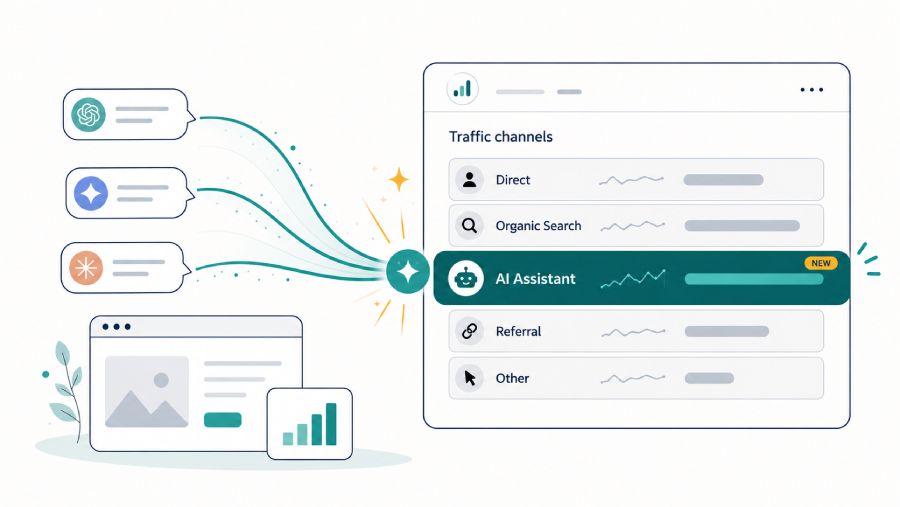
Once your GEO strategy is live, you’ll want to track its impact. Read our guide on how GA4 now attributes leads sent by ChatGPT to see this in action.
You might be really excited about this new opportunity for business growth, but you simply can’t dedicate the time and resources to GEO.
If that’s you, then not to worry. It’s our job to optimise estate agency websites for the new era of AI, whether by automating your blog posts or engineering your website content so that it dominates AI search results for your customers’ questions.
Get in touch if you’d like to win more leads through your digital content – whether through GEO, SEO, email campaigns, social strategy or a combination.
Generative Engine Optimisation (GEO) is the process of optimising your website and digital presence so that AI tools and AI-powered search engines mention or link to your business when answering questions. This includes platforms such as ChatGPT, Google AI Overviews, Gemini and Perplexity. GEO focuses on making your content structured, trustworthy and relevant so that AI systems can easily understand and cite it when generating responses.
While SEO aims to rank webpages in traditional search engine results, GEO aims to ensure your content is referenced directly in AI-generated answers. Both strategies share similar foundations—such as high-quality content, strong website structure, and backlinks—but GEO also focuses on structured data, authoritative sources, and content designed to answer specific questions that AI systems can easily summarise.
AI search is becoming increasingly common, with tools like ChatGPT and Google AI Overviews answering user queries directly instead of showing only traditional search results. As a result, businesses need to optimise their content so that AI systems recognise and recommend them as credible sources. Companies that adopt GEO early can gain visibility and leads from AI-driven searches before their competitors do.
To appear in AI search responses, businesses should focus on creating well-structured, authoritative and relevant content. Key tactics include using structured data, answering common customer questions, building high-quality backlinks, and maintaining strong online reviews and brand mentions. AI tools analyse information from across the web, so improving your brand visibility and credibility online increases the chances of being cited.
Content that directly answers user questions performs best for AI optimisation. This includes FAQs, detailed guides, case studies, statistics and well-structured blog posts. AI systems favour content that clearly demonstrates expertise, authority and trustworthiness, often referred to as EEAT (Experience, Expertise, Authoritativeness and Trustworthiness) in search guidelines.
Generative Engine Optimisation is a long-term digital strategy, similar to SEO. Improvements in AI visibility may take several months as search engines and AI tools discover, evaluate and reference your content. However, once your brand is recognised as a trusted source, AI systems may consistently reference it when answering relevant questions, leading to sustained visibility and traffic.








"*" indicates required fields