






How to Do a Content Marketing Competitor Analysis for Estate & Letting Agents


Content marketing for an estate or letting agency never happens in isolation. Every landlord guide, area page, and market update you publish is competing for attention, not just with the agency down the road, but with what shows up first on Rightmove and Zoopla, and increasingly with what ChatGPT or Google’s AI Overview says when someone asks “who’s the best letting agent in [town]?”
If you’re not looking at what your competitors are doing with their content, social media, and search visibility, you’re planning blind. Below are six tried and tested ways to run a proper competitor content analysis, built specifically around how estate and letting agents actually compete: against other local agents, corporate chains, online-only players like Purplebricks, and the portals themselves.

Start with the basics: what is your competition putting out, and how often? Are they publishing landlord guides on the Renters’ Rights Act, hyperlocal area pages, monthly market updates, or a mix of all three? A competitor publishing weekly is telling you something about the resource they’re putting behind content, and the topics they cover tell you what their target audience is asking about.
The easiest way to track this without manually checking websites every day is to subscribe to competitor newsletters and pull their blog feeds into a reader.
Look specifically for gaps: are they covering EPC changes but ignoring Section 21 reform? Publishing generic “moving house tips” but no local market data? Those gaps are your content opportunities.
A lot of an agency’s content marketing never touches their blog at all; it lives entirely on Instagram, Facebook, and LinkedIn. Valuation offers, “new instruction” posts, video walkthroughs, and guaranteed rent ads are often where agents spend the bulk of their content and ad budget.
If you want to go further, browser extensions like My Ad Finder can collect ads as you scroll your own feed. They’re useful, but they request fairly broad tab permissions, so it’s worth reviewing what access you’re granting before installing one. For most agencies, Meta Ad Library alone covers this job without needing an extension at all.

This is the part of competitor analysis that’s specific to property, and it’s the one most generic marketing advice misses entirely. Your real competition often isn’t visible on Google at all; it’s sitting in the same Rightmove or Zoopla search results as you.
If review volume and recency is a gap for your agency specifically, it’s worth reading our guide to review management software for estate agents, since this is usually the fastest lever to move.
Site speed and mobile performance directly affect both search rankings and whether a visitor sticks around long enough to enquire. A landlord who’s just clicked through to compare three local agents won’t wait around for a slow site to load.
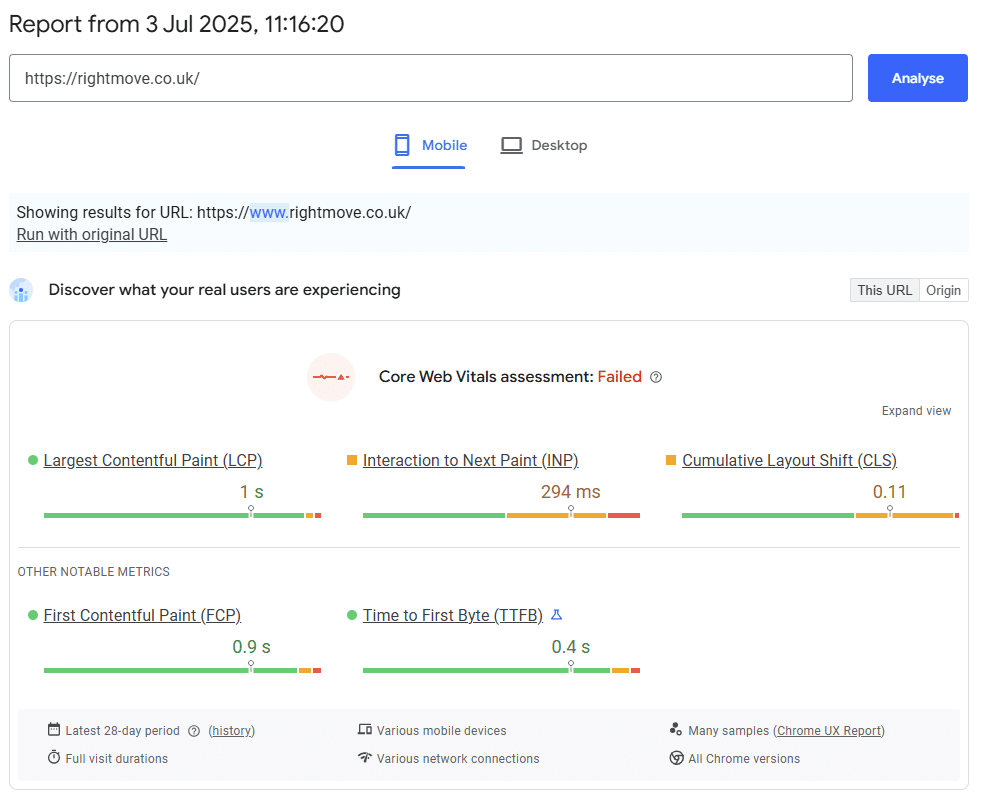
Run any site, yours or a competitor’s, through Google PageSpeed Insights for free. It works the same way regardless of whether you’re testing a national portal or a small independent agency site, so it’s worth benchmarking both: portals like Rightmove set the speed expectation buyers and landlords are used to, and your own site is competing against that expectation as much as it’s competing against the agency next door.
If your own site comes back slow, follow Google’s recommendations to fix it, and consider a CDN to serve content faster to visitors outside your immediate area.
Ranking above a competitor for “guaranteed rent [town]” or “sell my house fast [area]” is worth more than almost any other content marketing activity, because it captures people actively searching with intent.
Tools like SEMrush let you see exactly what a competitor ranks for, which pages drive their organic traffic, and which keywords they’re spending on through paid search. Pair this with Google Alerts set up for competitor brand names, so you’re notified whenever they get mentioned or covered elsewhere online.
Look specifically for:
Our SEO services for estate agents page covers how we approach this in more depth if you want a fuller audit done for you.
This is the newest and fastest-growing part of competitor analysis, and one that didn’t really exist as a discipline this time last year. People are now asking ChatGPT, Perplexity, and Google’s AI Overview questions like “who’s the best letting agent in [town]” or “how much does an estate agent charge to sell a house” and acting on the answer without ever seeing a traditional search results page.
Run a handful of these queries yourself for your area and see which agents get named. It’s usually the agents with clear, structured FAQ content, consistent business details across the web, and strong, recent reviews who get cited. If a local competitor keeps coming up and you don’t, that’s a visibility gap worth closing.
We cover why this matters for lead tracking specifically in GA4 Finally Knows When ChatGPT Sent You a Customer, and our AI Search Optimisation service is built specifically around winning this kind of visibility for property businesses.
| What to check | Tool | What it tells you |
|---|---|---|
| Blog and content topics | BuzzSumo, Feedly | What they publish, how often, and what performs |
| Paid social ads | Meta Ad Library | Live ad creative, offers, and how long ads have run |
| Organic social engagement | Fanpage Karma, Phlanx | Genuine audience engagement versus follower count |
| Portal and listing presence | Rightmove, Zoopla, OnTheMarket | Featured placement, photography, and listing quality |
| Local reputation | Google Business Profile | Star rating, review volume, and review recency |
| Site speed and UX | Google PageSpeed Insights | Load speed on desktop and mobile |
| Organic keyword rankings | SEMrush, Google Alerts | Search terms they rank and bid for, and top backlinks |
| AI search visibility | ChatGPT, Perplexity, Google AI Overview | Whether they get recommended for local property queries |
Content marketing for property businesses is a constant process, not a one-off project. Understanding what’s genuinely working for the agencies, chains, and portals you’re up against is what lets you improve on it rather than guess at it.
Run through the tactics above, keep the checklist handy for your next content planning session, and you’ll have a clearer picture of exactly where you can pull ahead.
If you’d rather have a content strategy built for you, backed by proper competitor and market research, talk to us about content marketing for estate and letting agents. We can also help you win visibility in AI search results through our AI Search Optimisation service.
A full review every quarter is usually enough to spot meaningful shifts, but it’s worth a quick check before planning any new content calendar or campaign, so you’re not duplicating something a competitor has already covered well.
Yes. Everything covered here uses publicly available information and tools, such as a competitor’s published blog content, their public social posts, and Meta’s own Ad Library. None of it requires logging into a competitor’s accounts or accessing anything non-public.
Direct local rivals covering the same postcodes, any corporate chain branch operating in your area, and online or hybrid agents targeting your market. It’s also worth tracking the portals themselves, since Rightmove and Zoopla increasingly shape what buyers and landlords expect from a listing before they ever reach your website.
Meta Ad Library, Google Alerts, Google PageSpeed Insights, and a manual Google Business Profile comparison will cover most of this without any budget at all. A paid tool like SEMrush is worth adding once you want proper keyword and backlink data.
It’s growing quickly and is genuinely worth tracking now rather than waiting until it’s fully mainstream. Agents who already have clear FAQ content, consistent business details, and strong reviews are the ones AI tools tend to cite, so the groundwork overlaps heavily with good SEO and reputation management anyway.








"*" indicates required fields