






How Estate Agents Should Respond To Google Reviews (Good Or Bad)


As the one of theleast trusted professionsin the UK, estate and letting agents live or die by their reviews. It only takes a few irritated customers to erode your hard-won 5-star rating on Google or Trustpilot. When that happens, you get fewer enquiries and more awkward questions when it comes to dealing with new customers.
At the same time, positive Google reviews are not to be ignored either! A positive review – especially when specific and detailed – is an excellent PR opportunity and an asset for your business.
But how should you actually respond to reviews on your Google Business Profile?
Answer: If possible, you should always respond to reviews, whether they are good or bad. Both are opportunities to promote your good points or even clear your name.
This article explores how you can respond judiciously, with real examples provided.

Here are some essential points to bear in mind when you respond to any kind of review left by a customer and manage your online reputation:
“The agencies that build trust and grow their instructions from Google are rarely the ones with a perfect five-star average. They’re the ones who reply to all reviews, good or bad, so a prospective vendor can see exactly how the team behaves when something goes wrong.”
— Nelly Berova, Art Division
It’s a mistake to think you only need to respond to brand-sinking reviews. Yes, that may act as damage control, but responding to a positive review on your Google Business Profile may help you grow your business. That’s even better.
This is an obvious one. Start with a sincere ‘thank you’ for taking the time to share positive feedback. You don’t need to sound overly emotional or ‘praise starved’, but you need to acknowledge the fact that someone has taken the time out of their day to say something positive about your brand.
The difference between a positive and negative reviewer is that the former has nothing personal to gain from reviewing you, so it’s extra special. Try to treat it as such in your response.
For maximum positive effect, you must be specific. Even if the customer hasn’t had the time to state the exact service you gave them, you can slip it into your response. For example:
Reviewer: “Amazing customer service from X estate agents, can’t recommend them enough!!”
Response: “Thanks so much for taking the time to write us a positive review. We’re glad we could chase down that buyer who was ready to walk away! – Hope you’re enjoying your lovely new home.”
OR
“Thanks so much for taking the time to write us a positive review. We really appreciated your patience with us during the conveyancing, and we’re glad to see it all paid off in the end!”
If you can mention what you did for your customer explicitly, then do. Equally, make reference to any specific products or services they benefited from (e.g. property management, guaranteed rent, etc.). However, don’t go overboard and start listing all the good things you did for them!
Another useful way to promote your business is to reinforce what you’re good at through positive reviews. For example, if you’ve built your business around helping sellers achieve above their asking price, then you should mention this where appropriate.
For example:
“Thanks so much X estate agents! Can’t believe you helped us exceed our asking price.”
“No problem, that’s our speciality, and we’re so glad it worked out so well for you!”
You get the idea. Wherever reasonable, reinforce the qualities that make you stand out as a business. This will help anyone skimming through your reviews to spot the trend and see your company values proven in action.
Anyone willing to write you a review is a prime target for further marketing – and advocating for your brand. For example:
This agent went a long way to ticking all the boxes: it expresses gratitude meaningfully, it’s quite specific and it reinforces their agency values (‘not taking anything for granted’).
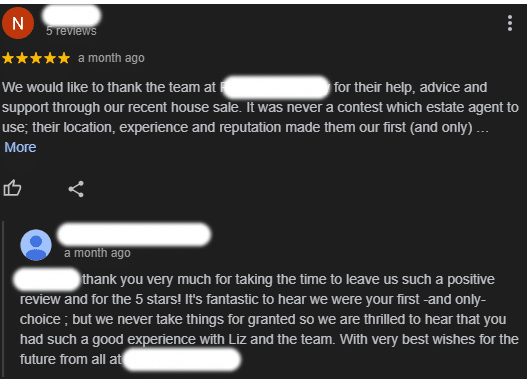
Again, this example is a concise and thankful review which invites further communication in the future. Like the above review, the reviewer provided a lot of specific detail, meaning the owner did not have to include as much.

This review (and response) stands out for its personal nature – it is a note of thanks regarding a specific staff member. Once more, this response strongly promotes their services and staff and is very specific – it also invites further engagement.

For many estate and letting agents, responding to bad reviews is a major concern – especially if they are only a small agency dealing with a few customers. Those can really hurt. So, how do you go about addressing customer reviews, especially if they are negative?
Your aim should never be to vent anger, insult, threaten or slander a bad reviewer – that could land you in legal trouble. Rather, you want to offer a response that:
Placates the bad reviewer.
Helps you explain yourself to other review-readers.
Shows you’re trying to find a positive solution to the situation.
If you go in with that attitude, you are likely to offer a much better response that positively impacts your angry customer and people browsing your reviews.
It’s no good responding to a review weeks after it has been written. Most review platforms note when your response is given, and when this is the case, it sends a bad message to other potential customers if you respond very late! Aim to respond to reviews in about 48hrs. That way, you will appear professionally concerned, but also not too eager for a fight (responding to a review 1 second after it’s been given is a red flag).
You should do this for even the most outrageous reviewers. There is always a reason why someone has bothered to leave you a bad review – even if it is not your fault. They may have not read the contract properly, an unconnected surveyor may have missed problems on their home…or they might just be having a bad day, and amplify the little problems online.
However, there is a difference between acknowledging frustration and accepting blame. There is a major difference between saying:
“I’m sorry you feel that way about our service” and “I’m sorry our service has failed you.”
Both acknowledge the bad experience, but the second one accepts blame as well. You need to assess the situation carefully to discern which option is appropriate.
The offended customer and the public both appreciate solutions. If it is possible to rectify the problem which caused the bad review, then say this explicitly in your response. For example:
“I’m sorry X has happened. We will refund you X amount to compensate for the misunderstanding”
It will be up to you to think of appropriate compensation, or even to have a standard policy in place to tackle failures in service. Whatever the case, you should review – and communicate – any reasonable steps you are going to take to fix the situation.
Sometimes a bad review is the result of a serious failure or particularly complex situation. If so, it might be best to respond to the bad review by inviting the customer to have a phone conversation or meet in person.
This has several advantages. It prevents a tediously long review, it shows care for the customer, and hopefully acts as online ‘damage control’ since the conversation exists on your review page.
It’s all well and good to hear what makes a good response in principle, but even better to see good review responses in action! Here are a few real examples from some of our clients.
This balanced review describes a genuine service failure, but the agency responds well. They acknowledge what has gone wrong, they take responsibility, and they offer a solution (to get in touch, and an endeavour to learn from the experience).

While this response is on the lengthy side, it is extremely clear and explains the situation precisely. In this instance, the agent has to respond to a failure which was not their fault, but which made the potential customer (understandably) annoyed. Unlike the example above, the agent successfully acknowledges frustration, but does not admit blame (as it is not their fault). They also manage to offer a solution (a future viewing) and affirm the reviewer with a hope for future business.

This might just be the most important example. Often, reviewers leave a low rating without further explanation. At this point, the agent needs to decide carefully how to respond. While the reviewer gives zero information about their grievance, the agent recognises who they are and offers a concise response. They acknowledge frustration, explain the specifics of the problem (which the reviewer does not), explain how they tried to fix the problem, and end by saying they want to do better in future.

There’s nothing better than a good old template to speed you on your way, and make your review writing faster – and according to the principles we’ve described in this article. So here are four review template examples you can adapt for your estate agency. Enjoy!
Dear [Reviewer Name],
Thank you so much for your kind words! We’re truly delighted that you had a positive experience with [specific service they mention, if applicable]. It’s our goal to make [reiterate a core value or strength of your agency] for all our clients.
We’d be honoured if you would share your experience with friends and family looking for [type of service – buying, selling, renting]. And should you ever need our services again, please don’t hesitate to reach out!
Warm regards, [Your Name] [Estate & Letting Agency]
Dear [Reviewer Name],
Thank you for taking the time to share your feedback. We sincerely apologise that your recent experience with us did not meet your expectations. Customer satisfaction is extremely important to us, and we’d like to address this issue directly.
Could you please provide more details about your experience, specifically regarding [mention aspect of service mentioned in the review]? Please contact us at [email or phone number] so we can discuss this further and work towards a resolution.
Thank you, [Your Name] [Estate & Letting Agency]
Dear [Reviewer Name],
Thank you for bringing your concerns to our attention. We sincerely apologise for the [specific issue mentioned in the review]. This is certainly not the standard of service we strive to provide.
We’d like the opportunity to make this right. Please contact us at [email or phone number] so we can discuss this in more detail and work towards a solution that addresses your concerns.
Thank you, [Your Name] [Estate & Letting Agency]
Dear [Reviewer Name],
Thank you for sharing your feedback. We’re concerned to hear about the situation you described and the way it’s made you feel.
To clarify, [briefly explain situation or agency policy that contradicts the review]. Please reach out to us directly at [email or phone number] so we can investigate this further.
Thank you, [Your Name] [Estate & Letting Agency]
Growing your Google reviews is yet another responsibility. It takes time; however, the benefits are far greater than ignoring.
Positive reviews can help boost credibility and make potential customers trust you more. Since trust is an important factor when a vendor or a landlord instructs an agent, reviews can make you seem more trustworthy.
But asking for reviews comes with its own challenges – you often do not know, for sure, if the client is going to give you a positive or a negative review.
So, to help estate agents grow their reviews AND ensure only the good ones end up in Google, we have developed our very own Reviews Module.

This very unique add-on, available to our website clients only, does a few things:
It aggregates reviews from all your Google accounts and combines them with your website testimonials.
It provides a dedicated page with all your reviews per branch and allows you to collect new reviews via your website.
It filters the good from the bad reviews and only encourages those who are happy to leave a Google review (4 or 5 stars)
It adds a widget to your website so people can quickly see your customers’ amazing reviews.
It provides you with an RSS link you can add to your social media tool to share your reviews across your social channels.
It adds stars in the search results for area pages, blogs and developments.
If you want to find out more, book a free Demo call below.
Responding to all reviews, both positive and negative, shows potential clients that your agency values feedback and is actively engaged with customers. This builds trust, improves your online reputation, and strengthens your local SEO signals on Google Business Profile. Consistently engaging with reviews can even help improve your visibility in local search results.
It’s best to respond to reviews as soon as possible, ideally within 24–48 hours. Quick responses demonstrate professionalism and attentiveness, which readers (and Google’s algorithm) see as a positive sign of customer care and engagement.
Positive reviews are an opportunity to show gratitude and reinforce your strengths, while negative reviews should be addressed with empathy, professionalism and a willingness to resolve issues. Thoughtful replies to negative feedback can often turn unhappy customers into loyal advocates.
Yes! Active engagement with Google reviews sends positive signals to Google that your business is trusted and relevant. This can improve your local search ranking and your chances of being featured in the Local Pack, boosting lead generation from nearby clients.
Art Division can manage your Google Business Profile, advise on how to craft professional responses to reviews, and implement review management strategies that build trust and strengthen your local SEO. We help estate agents turn reviews into a powerful part of their digital marketing and lead generation strategy. This service complements broader SEO work to ensure your business ranks higher and converts more local enquiries.
While templates can save time, personalised responses always perform better, especially when they address key points the reviewer raised. Customised replies feel more genuine to readers and show that your agency listens and responds thoughtfully.








"*" indicates required fields