






SEO for Estate Agents: How to Rank Higher, Win More Leads and Get More Valuations


SEO for estate agents isn’t about traffic for its own sake. It’s about being found when vendors, landlords, buyers and tenants search locally, and turning that visibility into valuation enquiries, landlord leads and instructions. Our SEO services for estate agents are built around exactly that objective.
Estate agency search has changed in 2026. Google, local packs, AI Overviews and AI assistants like ChatGPT now all influence how people discover an agency. But strong SEO remains the foundation underneath all of it, AI search largely draws its answers from well-structured, authoritative, crawlable websites, so the agencies winning in AI search are usually the ones who already got the SEO basics right (Source: Art Division client GA4 data, 2026, Google remains the largest traffic source by a wide margin, with AI assistants a small but growing contributor).
This guide covers what SEO actually is, why it matters for estate and letting agents specifically, what to prioritise, and how to turn rankings into enquiries.
SEO for estate agents is the marketing technique used to make your web content visible to people when they are searching for properties online. It’s about positioning your content as high up the organic (not paid for) search pages as possible. Your SEO strategy should include everything from technical aspects of your website’s construction, and the meta descriptions and tags you use behind the scenes, to the way your pages and blog posts are written.
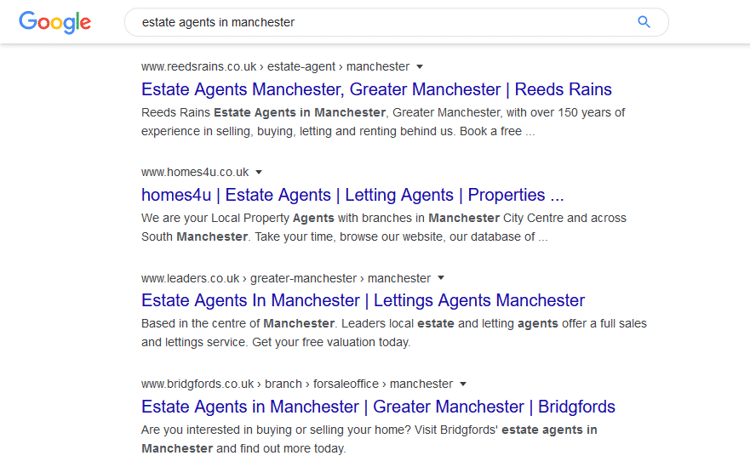
Vendors and landlords research an agency online before they ever pick up the phone, and buyers and tenants do the same before booking a viewing. If your website doesn’t appear when they search, a competitor’s does.
Search visibility matters for a few reasons specific to estate agents:
No matter how strong your photography or your pitch, none of it works if the site isn’t found.
SEO is only one part of a wider estate agent lead generation strategy, which should also consider website conversion, paid search, social media and AI visibility.
Optimising your site for search works in multiple ways, and it’s a complex area. Traditionally, SEO was about keywords – making sure your site includes the words people use when searching for homes or services in your area.
Keywords are still important, but Google has evolved, meaning that stuffing your content with keywords will actually have a negative effect. Poorly written copy will put customers off and Google will penalise you by lowering your ranking.
The key is to create high-quality, relevant content that considers the intent behind people’s searches and the context in which they are searching.
The commercial thread running through all of this: SEO isn’t a marketing line item measured in rankings, it’s a lead source, one that should be judged the same way as any other, by enquiries and instructions generated.
| Type | What it covers | Why it matters for estate agents |
|---|---|---|
| Local SEO | Google Business Profile, local citations, area pages | Wins the “near me” and “in [area]” searches vendors and landlords actually use |
| On-page SEO | Titles, headings, content, internal links | Tells Google (and AI search) what each page is actually about |
| Technical SEO | Site speed, crawlability, indexation, schema | Poor technical health caps how well everything else can perform |
| Content SEO | Blog posts, guides, area content | Targets the research-stage searches before someone’s ready to enquire |
| Off-page SEO | Backlinks, digital PR, citations | Builds the authority Google uses to trust your site over competitors’ |
| AI search optimisation | Structured, crawlable, well-sourced content | Determines whether AI assistants cite and recommend your agency |
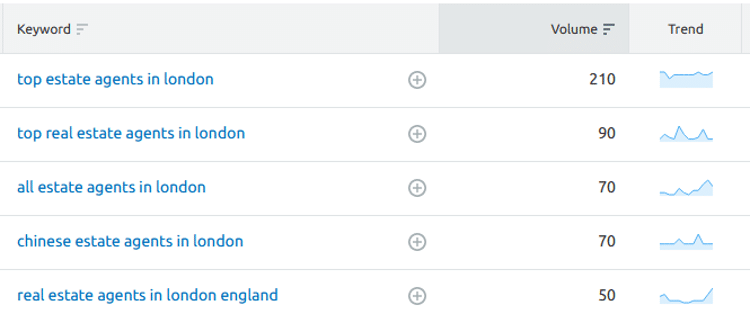
Keyword research means finding the words and phrases your actual audience searches, then judging which are worth targeting. Not every high-volume keyword is commercially useful, “houses for sale” gets huge volume but tells you nothing about location or intent.
| Intent | Example keywords |
|---|---|
| Service | “estate agents in [town]”, “letting agents in [town]”, “property valuation [area]” |
| Vendor | “how much is my house worth in [area]”, “sell my house in [area]” |
| Landlord | “letting agents in [area]”, “landlord services [area]”, “property management [area]” |
| Buyer/tenant | “homes for sale in [area]”, “flats to rent in [area]” |
| Advice/long-tail | “best places to live in [area]”, “schools in [area]”, “moving to [area]” |
| Commercial research | “best estate agent website SEO”, “estate agency SEO”, “SEO agency for estate agents” |
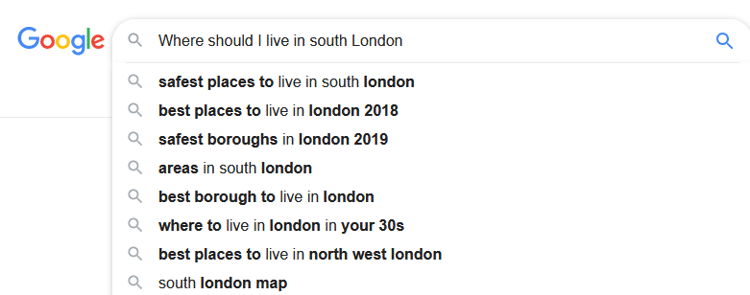
Long-tail, question-style searches (“where should I live in south London”) are worth targeting specifically because fewer sites bother optimising for them, making them easier to rank for and useful for capturing prospects still in the research phase. Weigh search volume against competition and genuine intent, ranking for a term nobody in your target audience searches isn’t a win, and a highly competitive national term is often worth less than a lower-volume, local, high-intent one.
Free tools like Google Keyword Planner and Google Search Console cover the basics; paid tools like SEMrush or Ahrefs add competition and gap analysis.
Local ranking factors are well-documented: Google Business Profile signals make up roughly 32% of local pack ranking weight, review signals around 20%, on-page signals 19%, and link signals 15% (Source: Whitespark, 2026 Local Search Ranking Factors survey). That ordering is a useful priority guide for where to spend time first.
Practical local SEO for estate and letting agencies covers:
For multi-branch agencies specifically, resist the temptation to run every branch through one generic “areas we cover” page, each branch performs better in local search with its own dedicated page, its own local content, and its own Google Business Profile.
A site can have great content and still underperform if the technical foundations are weak. For estate agency websites specifically, this means:
This article’s own technical audit is a useful example: slow load times, render-blocking scripts and slow server response all work against everything covered here. Technical fixes like these are a separate, ongoing workstream from content, not something copy changes alone can resolve, but they compound: a technically strong site gets more value from every piece of content and every backlink built on top of it.
Blogging remains one of the most efficient ways to build SEO, because it lets you target keywords your service pages can’t reach, area guides, market updates, moving advice, landlord compliance topics, without cluttering the pages built for conversion.
Google explicitly recommends responding to reviews, stating that doing so shows you value customer feedback and that strong positive reviews improve visibility. For estate agents, replying publicly to both praise and complaints is a credibility signal to both readers and to Google itself.
Review signals now account for around a fifth of local pack ranking weight (Source: Whitespark, 2026), so an active review strategy, encouraging genuine reviews and responding consistently, has real SEO value, not just reputational value.
Beyond reviews, your Google Business Profile itself is one of the biggest controllable levers in local search. A complete, accurate profile helps you compete for the Local Pack on “estate agents in [area]” searches, which drives both direct traffic and stronger general rankings.
See our full guide to getting your agency listed on Google Maps.
Backlinks remain a strong signal to Google that your site is a credible, citation-worthy resource, sites with more quality backlinks tend to earn higher rankings. For estate agents, valuable links tend to come from local press coverage, community partnerships, sponsorships, and genuinely useful content that other sites want to reference, digital PR, in other words, not just outreach for its own sake.
Quality matters more than volume, a handful of relevant, locally-authoritative links outperforms a large number of low-value ones.
AI Overviews and assistants like ChatGPT are a growing discovery channel, and they draw their answers from the same foundations that traditional SEO builds: clear, well-structured, authoritative, crawlable content. A site with thin content, poor structure and weak technical health is unlikely to be cited by AI search, regardless of how it performs in traditional rankings.
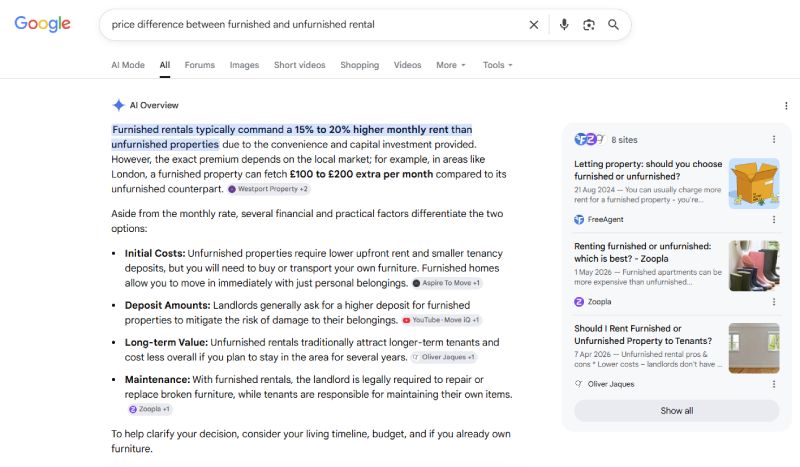
The practical overlap is large: schema markup, clear headings, direct answers near the top of a page, and genuinely authoritative content all help both Google rankings and AI citation. Estate agents optimising for one are largely optimising for both, so there’s little reason to treat “SEO” and “AI search optimisation” as separate projects rather than one strategy applied consistently.
SEO is a long-term strategy. Minor improvements can appear within weeks, but meaningful increases in rankings and traffic typically take 3-6 months or more, depending on competition and the strength of your current site. Regular reporting is essential so you can track genuine progress rather than judging results too early.
Rankings alone don’t tell the full story. Track a mix of:
Rankings are a leading indicator, enquiries and instructions are the outcome that actually matters, so tie reporting back to both.
Art Division specialises specifically in SEO for the UK estate and lettings sector, not general SEO applied to a property client. That means keyword research, content and technical work built around how vendors, landlords, buyers and tenants actually search, rather than generic best practice.
Our SEO work covers keyword research, content optimisation, technical SEO, and local search strategy, tailored into plans that attract more qualified traffic, improve rankings for the terms that actually matter commercially, and help you compete in local search. We also build SEO and AI-ready estate agency websites from the ground up, so the technical foundation supports the strategy rather than working against it, backed by regular reporting so you can see exactly how the investment is performing.
Being UK-based and a property-sector specialist means less time spent explaining the basics of how estate agency actually works, and more time spent on the SEO itself.
The practice of making your website visible when vendors, landlords, buyers and tenants search online, covering technical setup, on-page content, and authority-building, so your listings and service pages rank in organic search.
Through keyword research, content optimisation, technical SEO and local search strategy built specifically around the property sector, tailored into plans that attract qualified traffic and improve rankings for commercially valuable terms.
Minor improvements can appear within weeks, but meaningful ranking and traffic gains typically take 3-6 months or more, depending on competition and your site’s current strength.
Local SEO improves visibility for geographically specific searches like “estate agents in [area],” covering Google Business Profile optimisation, local keywords, citations and reviews.
Yes, quality content helps your site rank for more keywords, builds topical authority and earns backlinks, while giving AI search engines clear material to cite.
Yes, if anything it matters more: AI Overviews and assistants draw their answers from well-structured, authoritative websites, so the SEO fundamentals now support both traditional rankings and AI visibility.
SEO builds organic visibility that keeps working without ongoing spend, while paid ads (and portal listings) give instant but rented visibility that stops the moment you stop paying. Most agencies benefit from both, used for different jobs.








"*" indicates required fields